

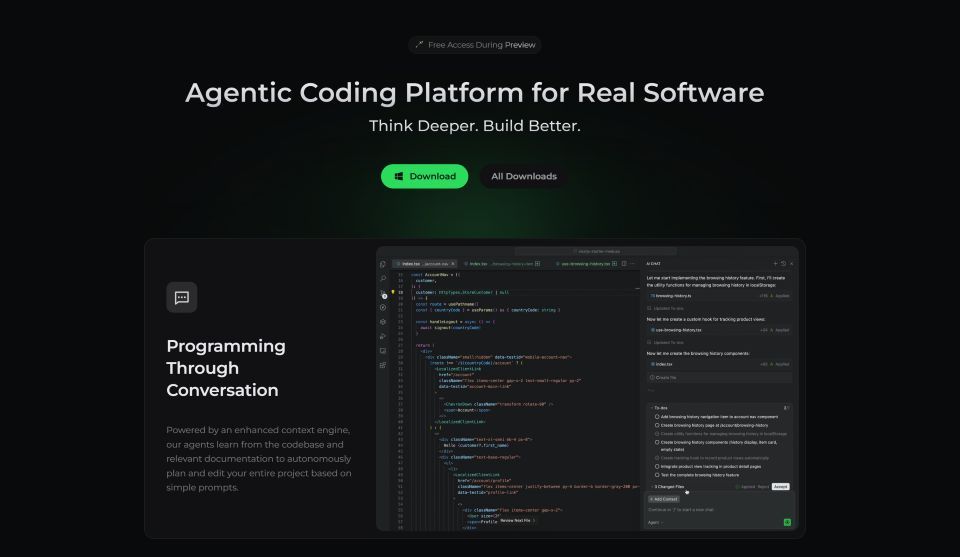
Qoder – The Agentic Coding Platform
Qoder is a next‑generation AI‑powered Integrated Development Environment (IDE) that brings agentic coding to professional developers. By embedding intelligent agents directly into the editor, Qoder can automatically ingest the entire codebase, build a deep contextual model, and then execute a wide range of software‑development tasks on demand.
Key Features
- Agentic Context Engineering – Qoder’s agents continuously analyze your repository, creating a structured knowledge graph of functions, classes, dependencies, and documentation. This enables the system to answer complex code‑base questions with high accuracy.
- Multi‑Model Support – Seamlessly switch between the latest AI models (Claude, OpenAI GPT‑4/‑4‑Turbo, Google Gemini, etc.) to balance cost, speed, and capability.
- Spec‑Driven / Spec‑First Workflow – Write specifications in natural language; the agents generate implementation scaffolds, unit tests, and documentation that stay in sync with the spec.
- Next‑Edit Suggestion – While you code, Qoder predicts the most logical next line or block, reducing keystrokes and cognitive load.
- Code Explanation & Refactoring – Ask the agent to explain any snippet, suggest refactors, or detect anti‑patterns.
- Automated Unit Test Generation – Generate comprehensive test suites (unit, integration, snapshot) based on code intent and specifications.
- Cross‑Platform – Native desktop clients for Windows and macOS with offline caching for privacy‑sensitive projects.
- Extensible Plugin System – Add custom agents, integrate CI/CD pipelines, or connect to internal knowledge bases.
Typical Use Cases
| Scenario | How Qoder Helps |
|---|---|
| On‑boarding a new codebase | Agents quickly map the architecture, produce high‑level diagrams, and answer “where is X defined?” queries. |
| Feature implementation | Write a spec, let the agent scaffold the feature, then refine with AI‑assisted suggestions. |
| Bug hunting | Ask the agent to locate the root cause of a failing test; it can propose patches automatically. |
| Legacy refactoring | Generate modern, type‑safe equivalents of old code while preserving behavior. |
| Continuous learning | Developers can query the agent for best‑practice patterns, security guidelines, or language‑specific idioms. |
FAQ
Q: Do I need an internet connection? A: Qoder requires connectivity to access the AI models. However, the local context engine runs offline, so you can still browse the knowledge graph without a network.
Q: Which programming languages are supported? A: Out‑of‑the‑box support for JavaScript/TypeScript, Python, Java, Go, Rust, and C#. Additional languages can be added via plugins.
Q: How is my code kept private? A: Only the abstracted context (AST, symbols) is sent to the AI provider; raw source files stay on your machine unless you explicitly enable full‑code transmission.
Q: Can I use my own LLM? A: Yes. Qoder provides an API hook for self‑hosted models that conform to the OpenAI‑compatible endpoint.
Q: Is there a free tier? A: A limited free tier is available with access to community models. Paid plans unlock premium models and higher usage quotas.
Bottom line: Qoder transforms the IDE from a passive editor into an active coding partner, accelerating development cycles, improving code quality, and lowering the barrier to complex, spec‑driven projects.


